
Match Miami Records by Event
A reliable Miami search starts with one event and follows its identifiers. Write down the full date, exact location, reporting agency, incident number, jail number, and case number as each becomes available. This matters in Miami because a common or compound name can produce several CJIS candidates, while a “Miami” mailing address can point outside city police jurisdiction. Compare the filing date, court division, charge, counsel, and status before treating a result as the intended case.
If the city report, booking entry, and court file disagree, obtain the final Clerk disposition. Send a claimed error to the office that created the field. A mismatch in a person’s own FDLE repository record belongs in FDLE Personal Review, not a broad public name search. A dismissal also does not erase an arrest report by itself. Florida sealing or expunction requires the applicable eligibility and court process, so certified court proof is often the clearest way to document what the court actually decided.
How to Check Criminal History in Miami
Start with the event, not a broad name search. A City of Miami police incident belongs to the Miami Police Department. A booking belongs to Miami-Dade Corrections, and a filed prosecution belongs to the Clerk of the Court and Comptroller. Statewide history is a separate FDLE product. This layered method prevents a missing result in one system from becoming a false claim that no record exists.
- Confirm the arresting or reporting agency from the incident number, citation, officer patch, or booking entry.
- Use the City of Miami public-records portal for an MPD report, affidavit, 911/CAD item, or body-camera file.
- Check county custody for a recent booking and save the jail number.
- Search the Clerk’s CJIS index by case, defendant, police, citation, or jail number.
- Use FDLE CCHInet or Personal Review only when the question requires a Florida repository record.
A known local case is usually best traced with free city and county channels before paying for a statewide name search. Exact numbers are more dependable than a common name.
Miami Police Records Portal
Miami lets a requester search prior public-record requests or create a new one. Searching released requests can save time, but an older response may cover a different date range, redaction decision, or document set. A fresh request should name the department, record type, event date and time, location, incident or case number, and officer or unit when known. Ask for electronic delivery and a cost estimate before extensive review.
The city warns that broad keywords and long date ranges can return thousands of records. Florida law permits many ordinary requests without a stated reason, although contact details help staff clarify scope and deliver files. The portal may track the request through an account.
The official Miami request page shows the city channel pictured below.
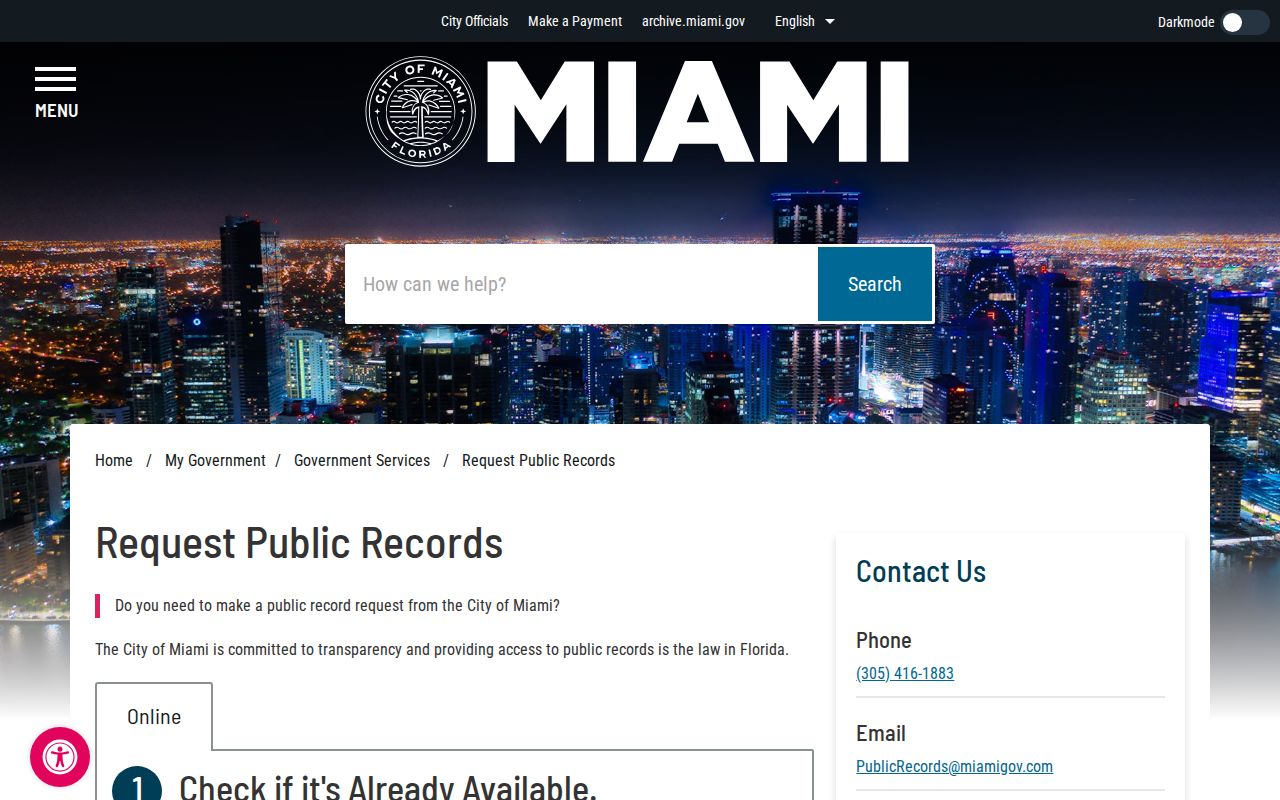
This interface is the right starting point for city-created police material, not a substitute for the county criminal docket.
The Miami Police Department
MPD creates incident reports, arrest affidavits, crash and enforcement records, and related media for events its officers handle. The records phone is 305-603-6477. A request for “everything about a person” is hard to identify and may require costly review. A bounded request for a final public incident report or arrest affidavit tied to one event is far more useful.
Agency identity matters. MDSO, Florida Highway Patrol, FDLE, airport or seaport agencies, and federal officers can act within the broad Miami area. Their records do not become MPD records merely because the event used a Miami postal address. The arresting-agency field on a booking entry is a strong routing clue.
Note: Mutual aid may create supplemental files at several agencies, but the lead agency is the best first custodian.
Miami or Miami-Dade Custodian?
“Miami” can mean the incorporated city, the county brand, or a mailing city for an unincorporated neighborhood. That makes records easy to misroute. Kendall and other county districts may use Miami in an address while MDSO holds the police report. Miami Beach and Coral Gables have separate departments. Confirm jurisdiction from the report, citation, unit markings, or arresting-agency field rather than the postal line.
| Record | Likely custodian | Best clue |
|---|---|---|
| MPD incident or arrest affidavit | City of Miami | MPD incident number |
| County booking | Miami-Dade Corrections | Jail number |
| Filed criminal case | Miami-Dade Clerk | Case or state case number |
| Florida repository history | FDLE | Accurate identity data |
The custodian rule is simple: the public agency that made or received a record in official business generally controls access to its copy.
Arrests and Bookings in Miami
An MPD arrest commonly moves into the county jail system. Corrections creates the booking file, jail number, photograph, fingerprints, custody status, bond fields, and facility location. Those fields describe intake and current custody. They do not prove the filed charge or final result. Someone released before a search may no longer appear in a current-custody tool.
Preserve the MPD police number and Corrections jail number. The first points to the city report; the second can bridge the booking to a new Clerk case even when name spelling varies. The Miami-Dade arrest history route covers county custody and agency-request options in more depth.
Miami arrest flow: MPD event › Miami-Dade booking › State Attorney charging review › Clerk criminal case.
Arrest is not conviction. Booking allegations can change, be declined, be dismissed, or end in acquittal. Read the later Clerk disposition.
Use Miami’s Jail Number
The jail number is one of Miami’s most useful cross-system identifiers. In CJIS, it offers an alternative to a name search and can link a recent county booking to the filed prosecution. This is valuable for compound names, two surnames, omitted accents, or common names.
If no CJIS case appears at once, the State Attorney may not yet have filed a charge, public data may still be updating, or the event may not become a prosecution. Search later and keep the city report request active. Never treat an early blank docket as a final legal outcome.
Miami Municipal Court Records
Miami does not operate a separate modern criminal trial-court index for felonies and state misdemeanors. County Court and the Eleventh Judicial Circuit handle those cases, and the Miami-Dade Clerk maintains CJIS. City citation, code, and administrative processes should be labeled narrowly. They are not substitutes for a criminal docket.
| Court Name | Miami-Dade County Court and Circuit Court, Eleventh Judicial Circuit |
|---|---|
| Case Types Heard | County Court handles misdemeanors, criminal traffic, and applicable ordinance matters; Circuit Court handles felonies. |
| Case Lookup Channel | Clerk Criminal Justice Online System, Clerk counter, or Records Management request. |
| What the Docket Shows | Filed charges, events, counsel, hearings, pleas, disposition, sentence, and linked identifiers when public. |
| Copies & Fees | Online images vary; request ordinary or certified copies from the Clerk and obtain a quote. |
A calendar proves that a hearing was scheduled, not that it occurred. Read the later docket entry for the result.
Riverside Is Not Criminal Court
Miami Riverside Center at 444 SW 2nd Avenue houses city administrative functions, including the public-record contact at PublicRecords@miamigov.com and 305-416-1883. It is useful for city-created records. It is not the place to obtain a certified felony judgment.
The City Clerk’s official office page provides the source for the municipal administration shown below.
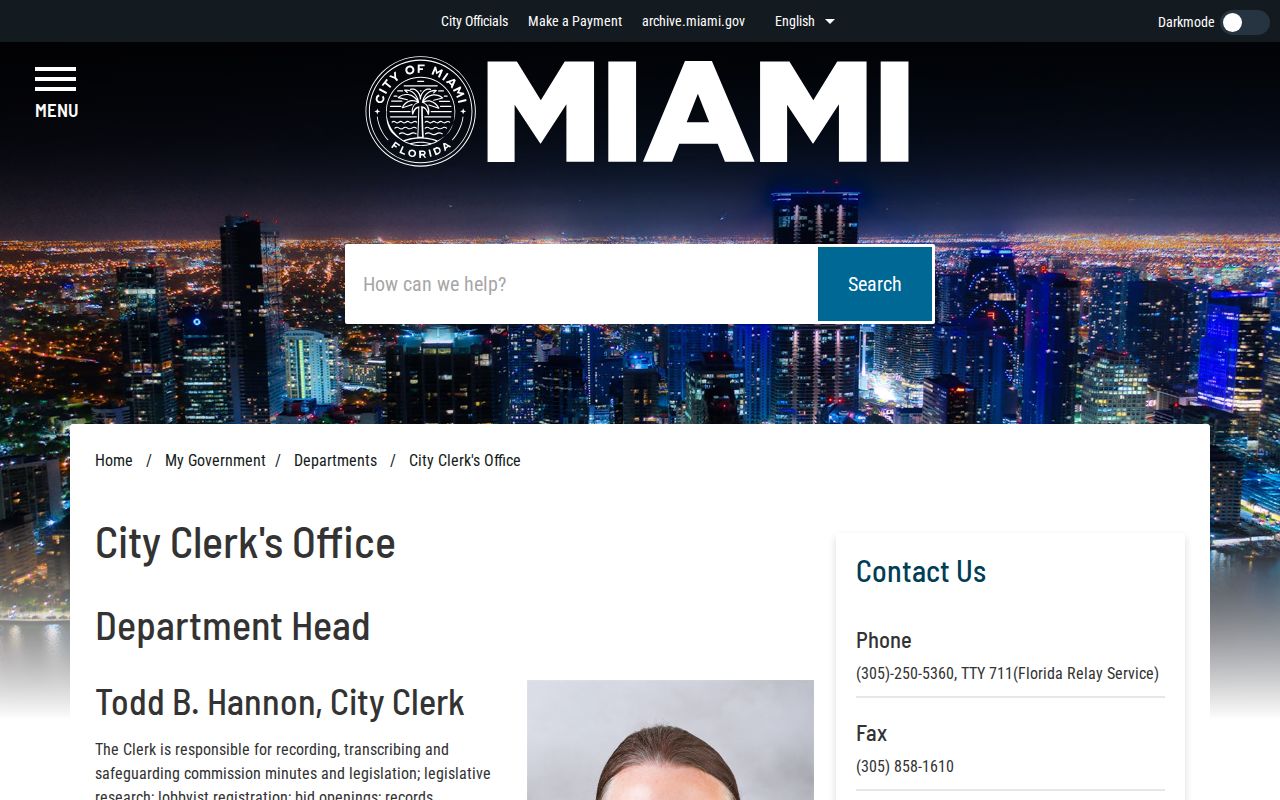
The image helps distinguish city administration from the downtown county justice offices that hold criminal court files.
Miami Public Records
Miami Riverside Center
444 SW 2nd Avenue, 9th Floor
Miami, FL 33130
305-416-1883
MPD Records
City of Miami Police records channel
305-603-6477
Verify current counter details before visiting.
Where Miami Records End Up
MPD retains its event file. Corrections creates a separate custody record. The State Attorney chooses whether and what to charge, and the Clerk opens the court case when charging papers arrive. Fingerprints and arrest-event data flow to FDLE, while final dispositions should later connect to the state cycle.
Record flow: Miami Police Department › Miami-Dade County Courts › Florida Department of Law Enforcement.
Each product answers a different question. The police affidavit explains the officer’s arrest basis. Booking shows custody. CJIS shows the filed posture and result. FDLE supplies a Florida repository search. Compare them rather than expecting one screen to contain the whole Miami criminal history.
Miami Ordinance or State Charge?
A city ordinance matter arises under local law, while the State Attorney files state criminal charges. County Court may hear ordinance matters within its jurisdiction, but that does not create a separate Miami felony court. Look at the prosecuting party, statute or ordinance citation, division, and filed charging document.
- Arrest affidavit
- The officer’s sworn account supporting an arrest; it is not the prosecutor’s final charge.
- Information
- A formal charging document filed by the State Attorney.
- Adjudication withheld
- A court outcome in which guilt may be found or admitted but formal adjudication is withheld; it is not a dismissal.
- Nolle prosequi
- A prosecutor’s decision not to continue a charge.
These distinctions keep a Miami records check from turning an allegation into a verdict.
Downtown Miami Record Geography
Government Center and nearby justice buildings put Clerk, court, prosecution, and defense functions close together, but the correct courtroom can change. Use the current hearing notice and docket rather than an old address. Security and counter rules may also change.
Port, tourism, airport, and federal activity add another layer. A federal case uses the Southern District of Florida and PACER, not CJIS. An airport, seaport, FHP, or federal report remains with the agency that created it. Venue alone does not identify the custodian.
Public Access Rules
Florida’s constitutional and statutory access rules cover city police records, but exemptions protect certain active investigative material, victim information, juvenile files, confidential identifiers, and sealed or expunged records. An agency should identify the exemption used and release segregable public portions when possible. Video and large electronic searches may require review and a special service charge.
Key Statutes:
Florida Public Records Law, chapter 119 defines public records and governs inspection, copies, fees, and exemptions.
Florida Statutes section 943.053 governs FDLE dissemination of criminal-history information.
Florida Rule of General Practice and Judicial Administration 2.420 governs public access and confidentiality in court records.
A concise Miami request should specify the exact report, date, location, and incident number. Ask for an exemption citation if material is withheld.