
Criminal Cases in Miami-Dade County Courts
The Eleventh Judicial Circuit divides criminal work by the level of the filed offense. Circuit Court hears felonies. Miami-Dade County Court hears misdemeanors, criminal traffic, and qualifying county or municipal ordinance matters. A police report from Miami, Hialeah, Miami Gardens, or MDSO does not create a separate municipal felony docket. Once a state criminal case is filed, the Miami-Dade Clerk maintains its public index and court file.
The arresting officer's allegation and the prosecutor's filed charge can differ. The Office of the State Attorney may file the same offense, change its degree, add or reduce counts, or decline prosecution. For that reason, a court docket answers what was prosecuted and how it ended. Booking data answers a different question. A case number, defendant name, approximate year, police or citation number, or jail number can connect those layers. Check every count because one Miami-Dade case can contain several charges with separate outcomes.
Miami-Dade Court Levels by Charge
Florida classification terms help route the search. Capital, life, first-, second-, and third-degree felonies belong in Circuit Court. First- and second-degree misdemeanors generally belong in County Court. The degree shown on a docket describes a statutory class, not the sentence actually imposed. Enhancements, offense-specific laws, and the court's final order can change the result.
| Court | Typical Miami-Dade criminal work | Record custodian |
|---|---|---|
| Circuit Court | Felonies and related proceedings | Miami-Dade Clerk |
| County Court | Misdemeanors, criminal traffic, qualifying ordinance cases | Miami-Dade Clerk |
| Federal District Court | Federal prosecutions in South Florida | Federal clerk and PACER |
How to Search Case Records
The free Clerk Criminal Justice Online System, or CJIS, is the main public index. It offers several routes because one identifier may appear before another. A newly booked person may be easiest to find by jail number. An older known matter is usually clearer by local or state case number. Police and citation numbers can bridge an agency record to the filed case.
- Open CJIS and choose the route that matches the identifier already known.
- Use a local or state case number when available; otherwise search the defendant index.
- Try the citation or police number route for an agency number, or the jail-number route after booking.
- Read the docket in date order and confirm later entries before treating a scheduled event as completed.
- Use the Clerk's criminal-court service for copies, certification, or an archived file that is not online.
| Search route | Input | Best use | Key caution |
|---|---|---|---|
| Case Number | Local or state case number | Known court matter | Enter the number in the displayed format |
| Defendant | Last and first name, optional middle name | Name search | Compare same-name candidates |
| Citation / Police Number | Agency or citation identifier | Linking a police record | Not the same as a court case number |
| Jail Number | Corrections jail identifier | New booking cross-search | A case may not yet be filed |
| Calendar | Date or division criteria | Scheduled court activity | A listing does not prove the hearing occurred |
The official CJIS interface shows these distinct paths.
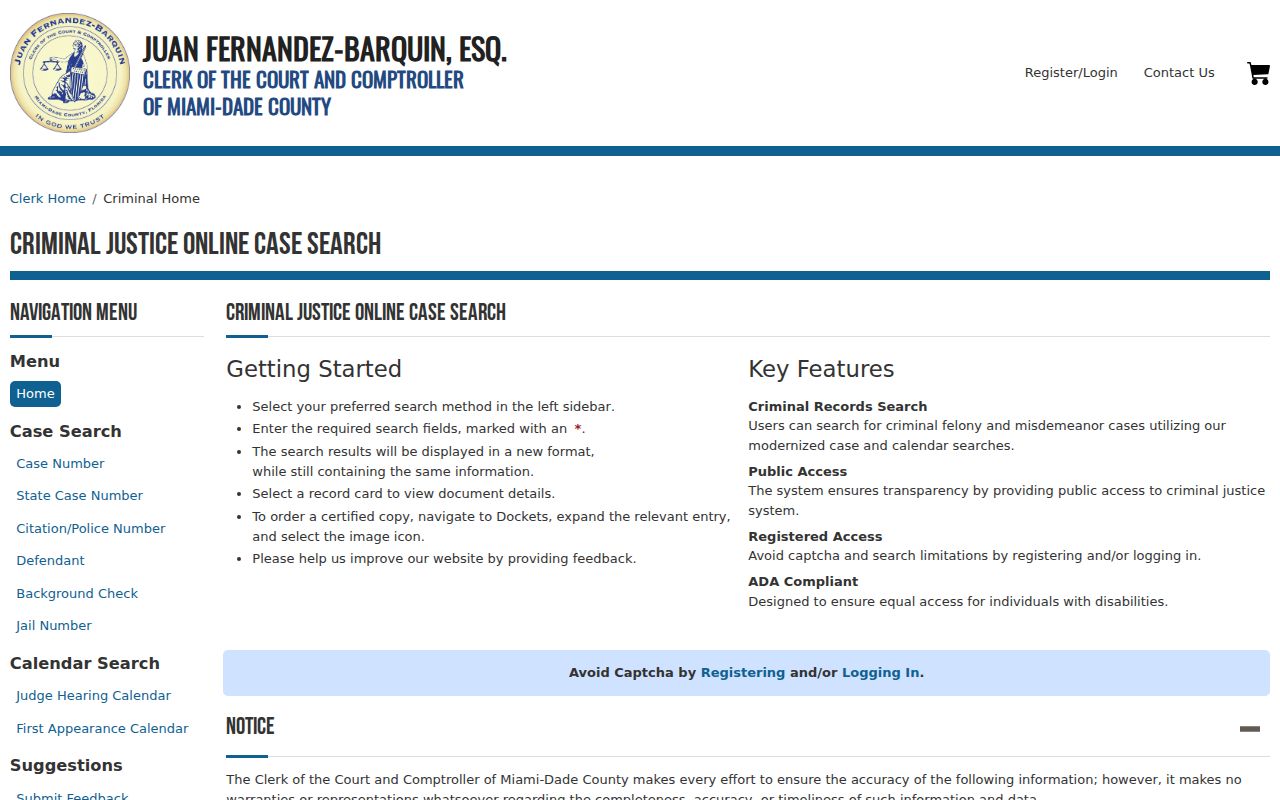
The route chosen should match the identifier on the source document, which cuts down false same-name matches.
Missing Miami-Dade Case Images
An index entry may be public even when its document image is absent. Older files can require Records Management retrieval. Other images may be withheld from remote viewing because of confidentiality, redaction, or court access rules. Give the Clerk the case number, captioned defendant name, approximate year, exact document title, and whether a certified copy is needed. Asking for the information or indictment, docket, disposition, and sentence is often more precise than asking for an entire file.
The Clerk's criminal-court service page provides the current access route.
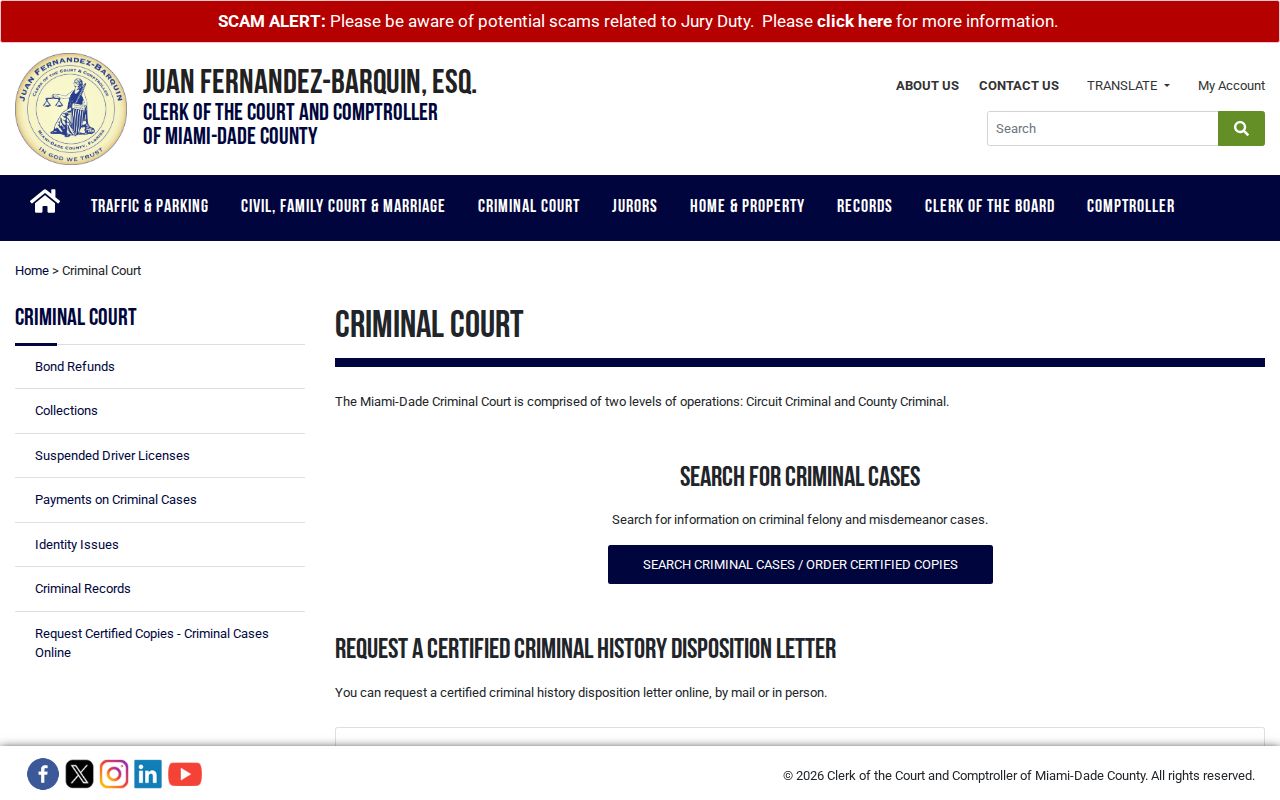
Use that official page to confirm current counter procedures before travel or a records request.
Note: A missing online image does not prove that the underlying filing is sealed or that no case exists.
What the Case File Shows
The docket is a dated list of filings and court events. The case file can contain the charging instrument, motions, pleas, hearing entries, orders, judgment, and sentencing documents. An “information” is a formal charge filed by the State Attorney. An indictment is a grand jury charging instrument. An arrest affidavit records the asserted basis for arrest; it is not the prosecutor's final filed position.
| Case Number & Court | Identifies the local matter, division, and Circuit or County Court. |
|---|---|
| Charging Document | Shows counts and statutes filed by information or indictment. |
| Docket Entries | Lists filings, notices, orders, and events in date order. |
| Hearing Dates | Shows scheduled activity; check later entries for what occurred. |
| Disposition & Judgment | States how each count ended and whether guilt was adjudicated. |
| Sentence & Conditions | Records custody, supervision, financial terms, or other ordered conditions. |
Read Miami-Dade Docket Outcomes
A single early entry rarely tells the full story. Compare the filed charge with the final disposition for each count. “Adjudication withheld” means the court withheld a formal adjudication of guilt after a plea or finding; it is not a dismissal. “Nolle prosequi” means the prosecution discontinued that charge. A capias is a court command to take a person into custody, often tied to a missed appearance or another court event.
- Arraignment
- The stage when the filed charge is addressed and a plea is entered.
- Disposition
- The final outcome for a count, such as conviction, dismissal, acquittal, or nolle prosequi.
- Adjudication withheld
- A Florida outcome distinct from both adjudication of guilt and dismissal.
- Capias
- A court-issued command for arrest or custody.
Stages of a Criminal Case
The arrest starts an agency record, but the Clerk file begins when charging papers reach the court. Arraignment addresses the filed accusations and plea. Pretrial entries can include discovery notices, motions, continuances, and negotiated resolutions. A case then ends through dismissal, plea, trial verdict, or another lawful disposition. Sentencing follows when required. Each count may take a different path, so readers should not apply one outcome to the whole case without checking the judgment.
Case flow: Charges Filed → Arraignment → Pretrial → Plea or Trial → Disposition → Sentencing
Miami-Dade Charging and Defense Records
The State Attorney decides which state charges to file. The Public Defender represents eligible people after appointment. Neither office replaces the Clerk as custodian of the public court docket. Their own work files may include confidential, privileged, or nonpublic material, while filed motions and court orders are sought from the Clerk.
The Eleventh Circuit State Attorney's official site identifies its divisions and services.

Its charging role explains why the offense in court may differ from the arresting officer's initial allegation.
The Eleventh Circuit Public Defender's official site describes appointed defense services.
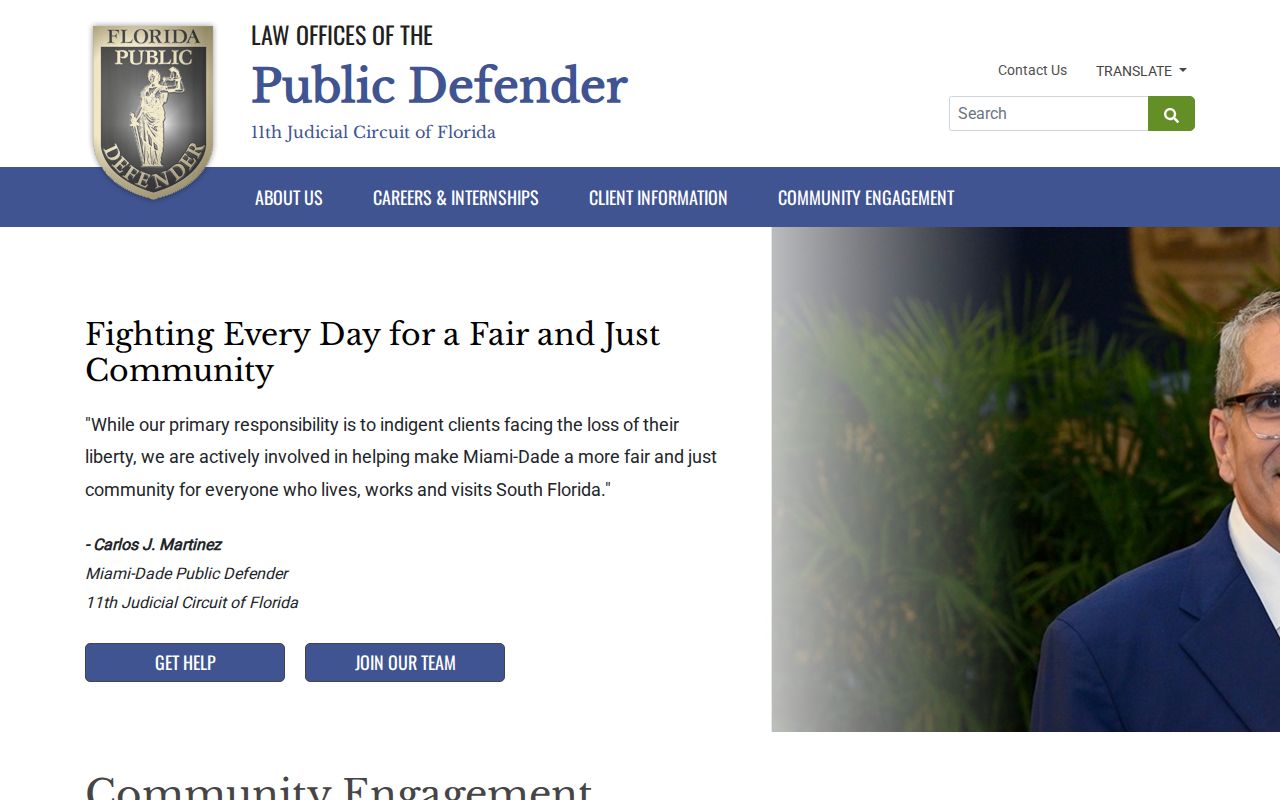
A defense office file is not a public substitute for the certified disposition maintained by the Clerk.
Miami-Dade Criminal Court Counter
The principal Clerk location is the Osvaldo N. Soto Miami-Dade Justice Center in the downtown government district. Bring a case number when possible, or the defendant name and an approximate filing year. Verify the assigned building for a hearing because criminal functions have also been associated with the Richard E. Gerstein campus and assignments can change.
Miami-Dade Clerk Criminal Court
20 NW 1st Avenue
Miami, FL 33128
305-275-1155
Confirm current counter access and hours before travel.
Access & Restrictions
Florida court records begin with a strong public-access rule, but access is not unlimited. Florida Public Records Law, chapter 119, works alongside judicial access rules, including Florida Rule of General Practice and Judicial Administration 2.420. Juvenile matters, sealed or expunged records, protected victim data, confidential health details, and active investigative information may be withheld or redacted.
Remote access can be narrower than lawful access at a counter. Ask the Clerk whether a record is available through inspection, a targeted request, or certification when CJIS shows only an index. If access is denied, request the authority for the restriction and any segregable public portion. A certified disposition is often the best court document for correcting an incomplete outcome in an FDLE personal record review.