
How to Check Criminal History in Miami-Dade County
Begin a Miami-Dade County criminal history search with the Clerk Criminal Justice Online System, or CJIS, when the main question concerns a filed county case. Search current custody next when an arrest is new. An arrest form comes from the arresting police agency, while the booking file comes from Miami-Dade Corrections. FDLE adds reported events from across Florida. These sources overlap, but none replaces all the rest.
Have the full name, spelling variants, an approximate date, and any case, police, citation, or jail number ready. Miami-Dade County names may include two surnames, hyphens, compound given names, aliases, or accents omitted by a database. Match dates, charges, court divisions, and record numbers before treating two entries as the same person.
- Search Clerk CJIS by case number when known. Otherwise, try defendant name, police number, citation number, or jail number.
- Check the county in-custody system for a recent booking and note the jail number, location, charges, and bond fields.
- Identify the arresting agency from the booking or affidavit. Request its public arrest form or incident report.
- Read the Clerk docket for the filed charge, disposition, and sentence. Do not substitute the arrest charge for the court outcome.
- Use FDLE CCHInet for a Florida repository search or FDLE Personal Review when auditing your own fingerprint-linked record.
Five Miami-Dade Criminal Record Systems
The same name can appear in five official systems because each custodian answers a different question. Miami-Dade County CJIS concerns court filings. Corrections reports current county custody. MDSO holds sheriff-created arrest and incident records. FDLE compiles Florida arrest and disposition cycles, while FDC covers state prison and community supervision.
| Official channel | Best use | Key limit |
|---|---|---|
| Clerk CJIS | Filed cases, dockets, outcomes | Not a statewide repository |
| County inmate search | Current custody and booking | Not an all-time arrest archive |
| MDSO Central Records | Sheriff reports and arrest forms | Does not hold every city report |
| FDLE CCHInet | Reported Florida criminal history | Name-based and fee-based |
| FDC Offender Search | State prison or supervision | Not a county jail roster |
Official Florida Background Checks
The FDLE Criminal History Information on the Internet is Florida's official public name-check portal. FDLE lists a $24 charge for each search, and the fee is not refunded when no record appears. The result is based on the submitted name and identifiers. It is not fingerprint confirmation, an FBI report, or a certified Miami-Dade County court disposition.
The official CCHInet interface shows how a statewide check differs from a free local docket search.
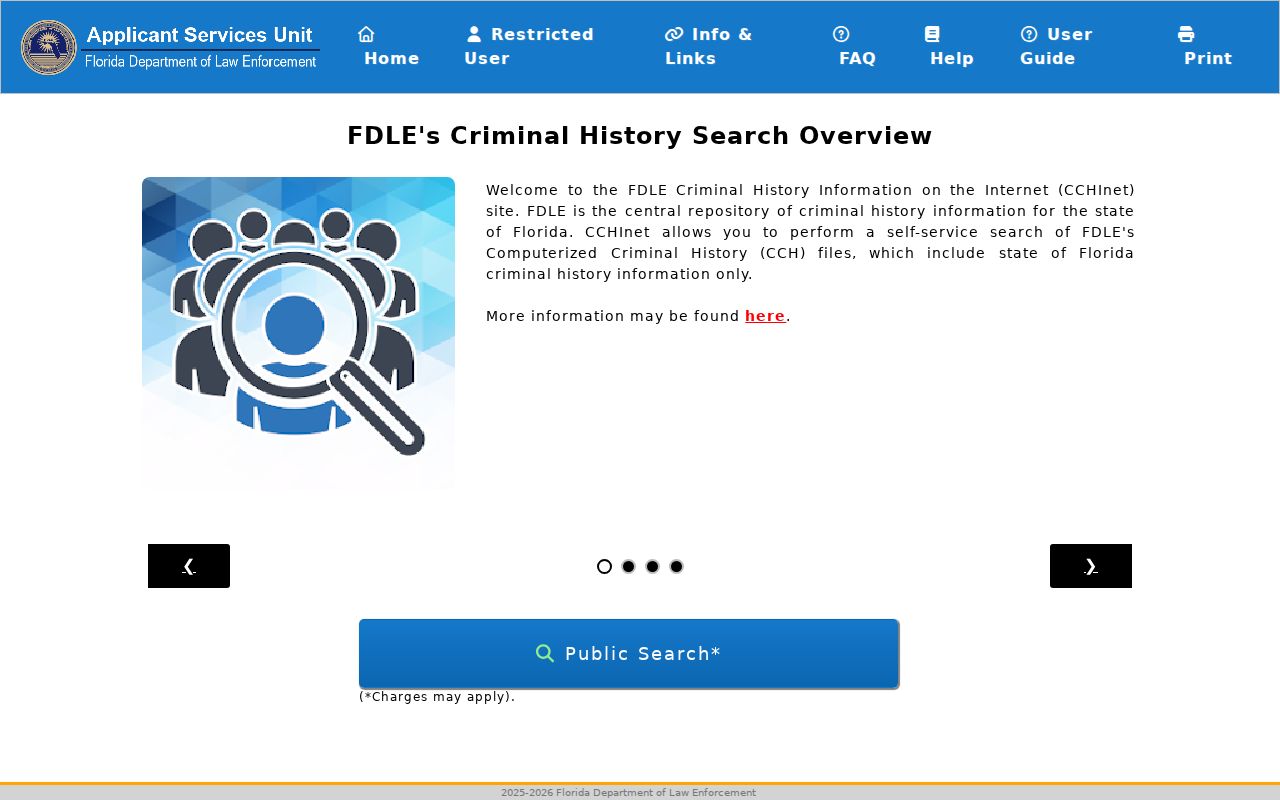
CCHInet adds Florida-wide scope, but a matching Miami-Dade County case should still be checked against the Clerk's filed docket and final disposition.
| Service | Published cost | Scope |
|---|---|---|
| FDLE CCHInet | $24 per search, nonrefundable | Florida name-based repository search |
| Public-record copies | Up to 15¢ one-sided or 20¢ two-sided | Standard pages under section 119.07 |
| Extensive request | Reasonable special service charge | Actual labor or technology use |
Correcting Miami-Dade Criminal History
Someone reviewing their own Florida record should use FDLE Personal Review. Fingerprints help FDLE tie the request to the right identity. If an arrest cycle lacks its disposition, obtain a certified disposition from the Miami-Dade County Clerk and follow FDLE's challenge instructions. A data error should be addressed with the agency that created it as well as the state repository when needed.
FDLE's Personal Review instructions identify the fingerprint-based route for self-audit and correction.
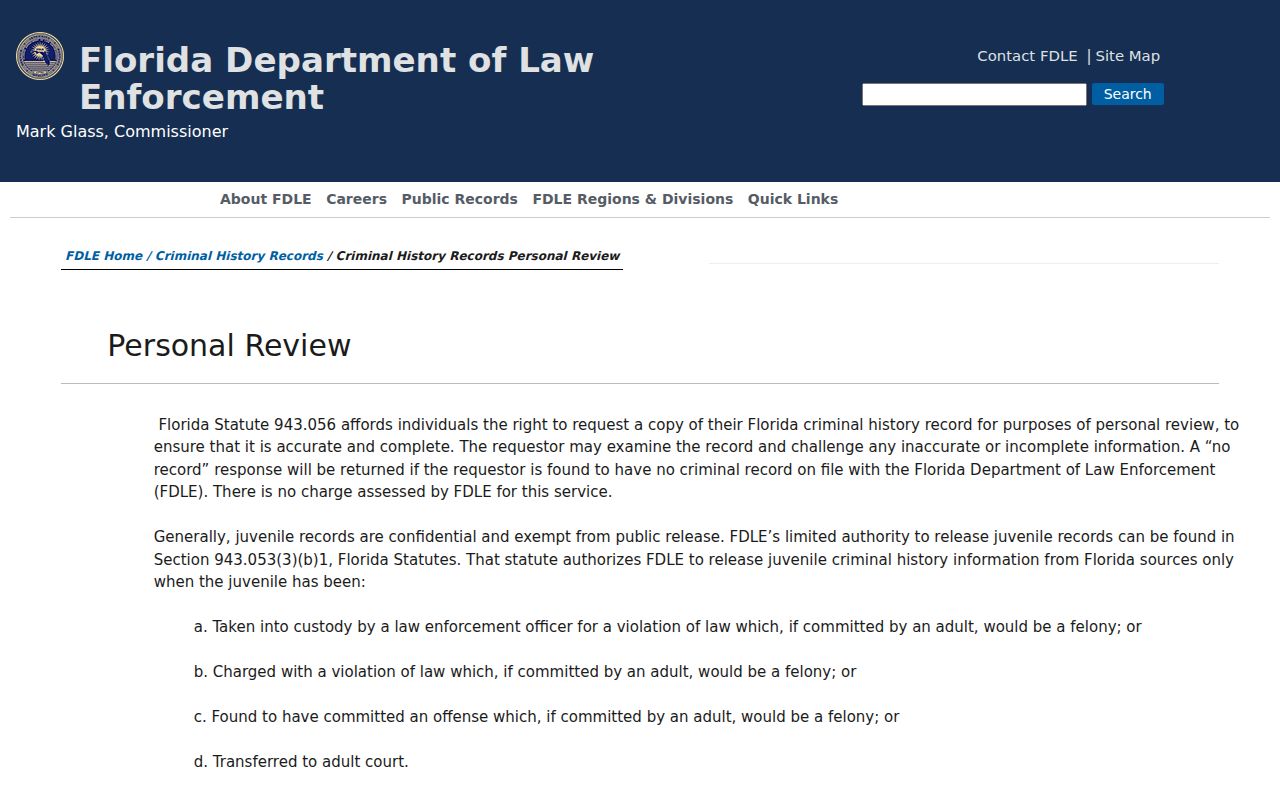
This process offers stronger identity assurance than a public name match, especially when common names or incomplete dispositions cause doubt.
Types of Criminal Records in Miami-Dade County
Miami-Dade County criminal records develop in stages. An investigator writes an incident report. An arresting officer may prepare a probable-cause affidavit. Corrections creates a booking record after intake. The State Attorney independently decides what charge to file, and the Clerk records each court event. FDLE later receives reported arrest and disposition data. One event can therefore produce several records with different dates, terms, and custodians.
- Incident or offense report: the investigating agency's account and evidence metadata, which may exist without an arrest.
- Arrest and booking record: the alleged offense, arrest authority, jail number, intake, custody location, and bond fields.
- Court case file: the charging paper, docket, motions, pleas, judgment, disposition, and sentence.
- Warrant or capias: a court command whose public status can lag behind recall or service.
- Repository or supervision record: FDLE history, FDC custody, probation, community control, or older parole information.
Search Miami-Dade Criminal Court Records
CJIS supplies several useful bridges between police, jail, and court records. The jail-number route is often helpful after a new booking because names can be misspelled while the booking identifier stays fixed. A police number can connect an agency event to a filed case. A calendar result only shows that a hearing was set, so read the later docket before drawing a conclusion.
| Search path | Input | Best use |
|---|---|---|
| Case Number | Local criminal case number | Exact known case |
| State Case Number | Uniform state format | Known statewide identifier |
| Citation or Police Number | Agency identifier | Linking police and court records |
| Defendant Name | Surname and given name | Use careful spelling variants |
| Jail Number | County booking identifier | Recent booking cross-search |
| Calendar | Judge and date | Scheduled hearing lookup |
The Eleventh Judicial Circuit publishes current division, judge, courthouse, and administrative information.
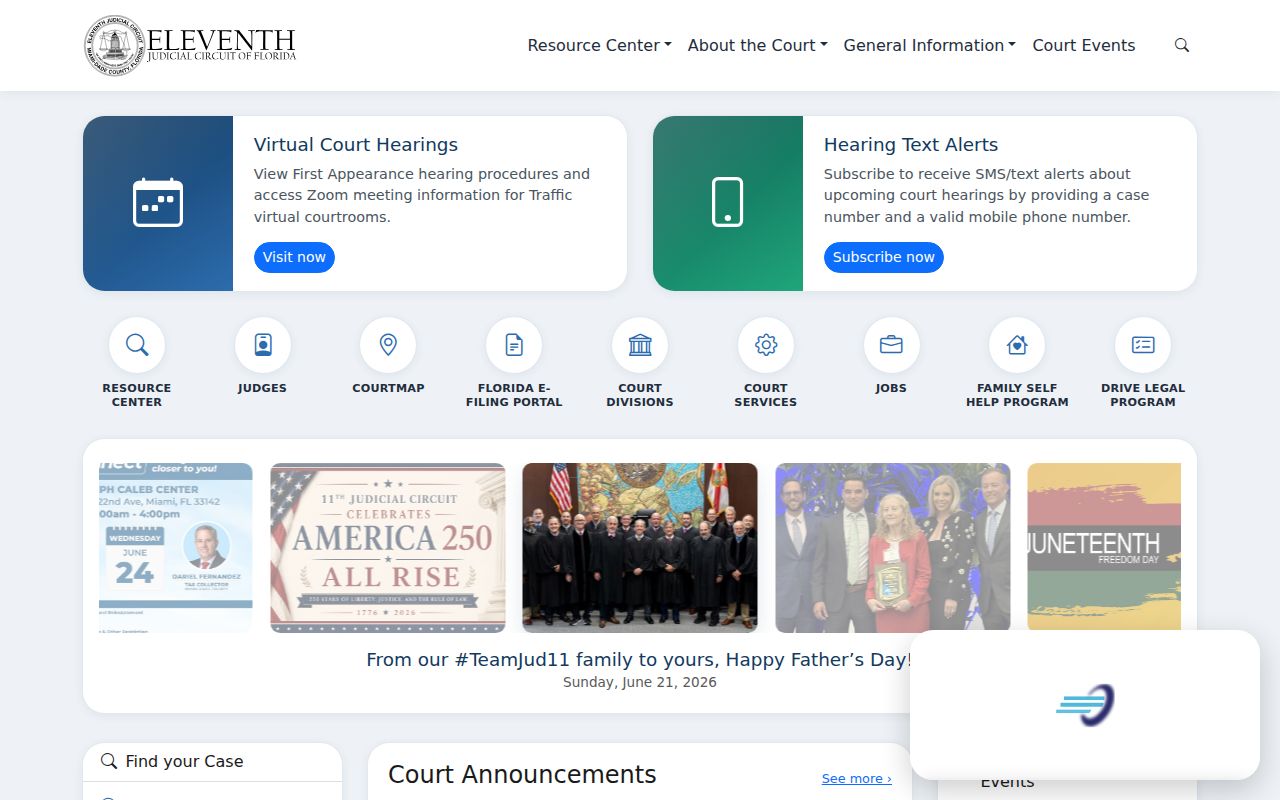
The circuit source helps confirm where a hearing belongs, while the Clerk remains the custodian of the filed judicial record.
What a Miami-Dade County Criminal Record Shows
A Miami-Dade County criminal record should be read as a set of linked fields, not a single verdict. Identity fields help distinguish people. Event fields show what an agency alleged. Court fields show what prosecutors filed and what the judge or jury decided. Public products can omit protected data, sealed material, or document images restricted under court rules.
| Name & Identifiers | Legal and alias names, date of birth, state or FBI numbers, and fingerprint-linked identity where authorized. |
|---|---|
| Arrest / Booking Data | Agency, arrest date, jail number, intake, custody location, charges, and bond information. |
| Charges & Statutes | Charge sequence, description, degree, statute, and the filed charging instrument. |
| Disposition | Adjudicated, adjudication withheld, dismissed, nolle prosequi, acquitted, or transferred. |
| Sentence | Jail, prison, probation, community control, fines, or other court-ordered terms. |
| Custody / Supervision | County detention, FDC prison, release, or state community-supervision status. |
Miami-Dade Warrant Record Fallbacks
No complete official public Miami-Dade County warrant name search was found in the research. Start with CJIS for a capias or warrant docket entry. Then contact the issuing court or Clerk division. The MDSO Warrants Bureau at 9105 NW 25th Street in Doral can provide allowed verification through 305-471-1700. Its desk works around the clock for law-enforcement research, but that does not create a public online list.
The official bureau page explains the sheriff's warrant role and direct channel.
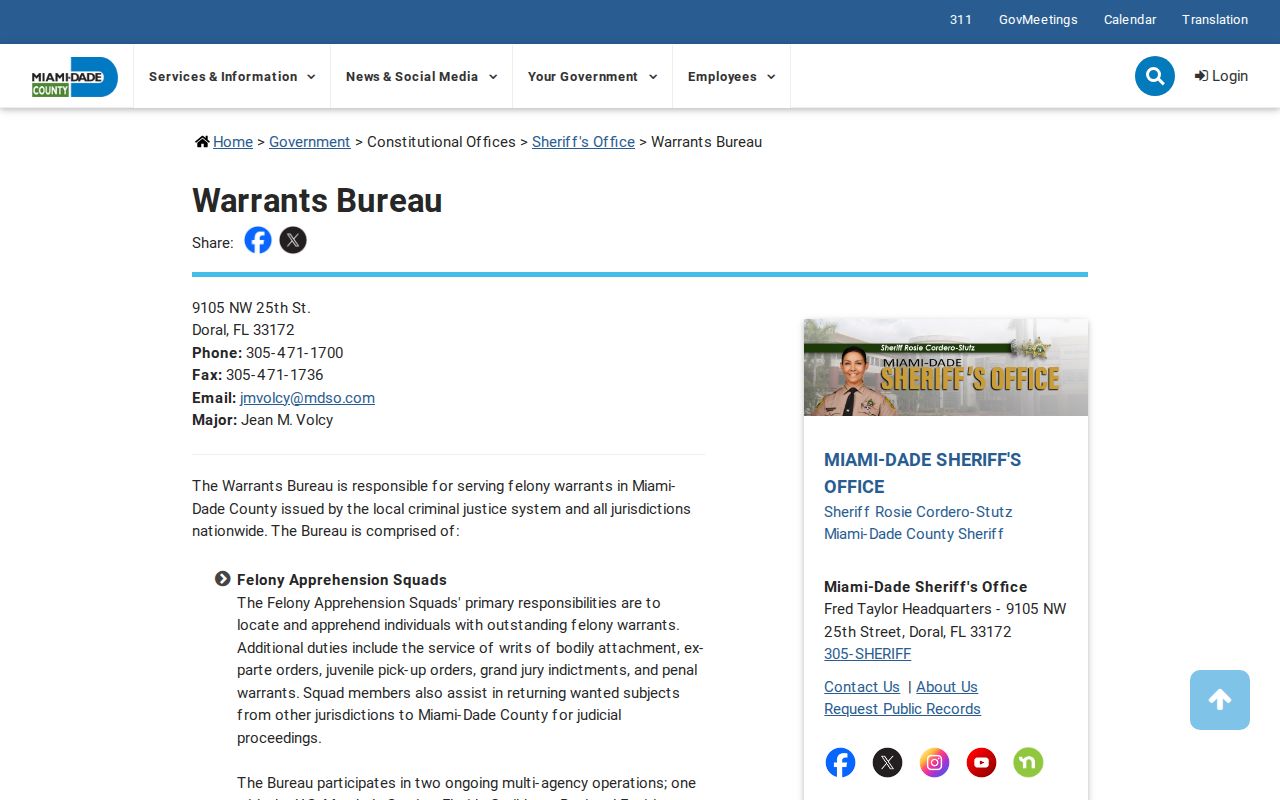
Urgent questions should be verified with the court and MDSO because an old screen capture may not reflect service, recall, or a new order.
Public Access Laws for Miami-Dade County Criminal Records
Florida's access rules allow inspection of many Miami-Dade County records, but they do not make every detail public. A custodian need not create a new report or answer questions. Exempt parts may be redacted while the rest is released. Active investigative material, protected victim data, juvenile information, undercover identities, security plans, medical data, and sealed or expunged records can be withheld under controlling law.
Key laws:
Florida Statutes chapter 119 sets public inspection, copying, fee, and exemption rules.
Florida Statutes section 943.053 governs FDLE criminal-history dissemination.
Florida Statutes section 943.0585 controls court-ordered expunction.
Florida Statutes section 943.059 controls court-ordered sealing.
Miami-Dade Court and Records Geography
A trip to Doral will not produce a certified court disposition. The Clerk's criminal counter is at the Osvaldo N. Soto Miami-Dade Justice Center, 20 NW 1st Avenue in Miami, with a main line at 305-275-1155. Historic criminal-court functions also use the Richard E. Gerstein Justice Building area. Current notices and the docket should confirm the assigned building.
MDSO Central Records sits at 9105 NW 25th Street in Doral and keeps sheriff reports and arrest forms. Miami-Dade Corrections headquarters is at 3505 NW 107 Avenue in Doral and handles detention records. This split reflects the county's justice map: court functions cluster near downtown, while major records and corrections administration operate farther west.
Clerk Criminal Records
20 NW 1st Avenue
Miami, FL 33128
305-275-1155
MDSO Central Records
9105 NW 25th Street
Doral, FL 33172
305-471-2070
Corrections Headquarters
3505 NW 107 Avenue
Doral, FL 33178
786-263-7000
Sealed, Expunged, and Restricted Records
Florida sealing makes an eligible record confidential from ordinary public access while specified agencies retain access. Expunction generally directs agencies to remove or destroy records, while FDLE keeps the limited confidential copy authorized by law. A dismissal does not produce either result on its own.
The usual route begins with an FDLE Certificate of Eligibility and then moves to a petition in the proper circuit court. Eligibility depends on the disposition, prior adjudications, earlier relief, and statutory exclusions. The certificate does not guarantee that the court will grant relief. After an order, verify implementation with the Miami-Dade County Clerk, arresting agency, Corrections, and FDLE.
- Sealing
- Restricts an eligible record from ordinary public view while authorized access remains.
- Expunction
- Directs removal or destruction under the court order, subject to FDLE's limited statutory copy.
- Nolle prosequi
- The State chose not to continue a charge at that time; it is not itself expunction.
- Adjudication withheld
- A court outcome distinct from dismissal, acquittal, and an adjudication of guilt.
Miami-Dade Custody Versus State Supervision
The Miami-Dade County inmate search reports present county custody, not a full arrest archive. A person can leave that roster after release or transfer. The FDC Offender Search concerns state prison and community supervision. County pretrial or monitored release also differs from sentenced felony probation through FDC Community Corrections.
The official FDC locator shows the state-level search layer.
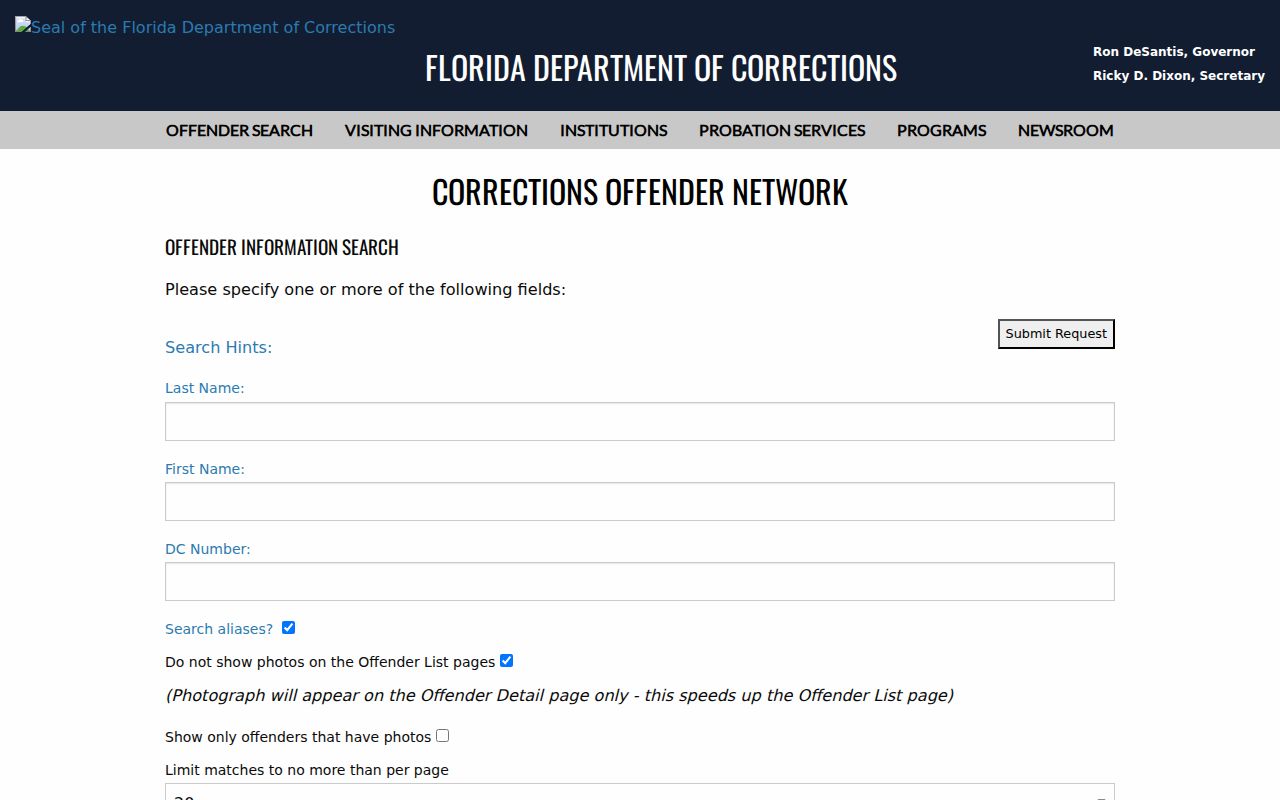
A missing county custody result may mean release or transfer, so check CJIS for the filed Miami-Dade County case and FDC when state custody is plausible.
The county's daily jail report adds context without naming a conviction. On May 21, 2026, it counted 4,679 people in custody, including 4,161 men and 518 women, plus 630 immigration holds or detainers. It also charted daily bookings and releases across four months. Those figures describe the detention system on one date. They are not a crime rate, an arrest list, or proof that each person was guilty. A hold is not a new conviction, and much of the jail population is awaiting a court result.
Florida largely ended parole for offenses committed on or after October 1, 1983, with older-case and specialized exceptions. The Florida Commission on Offender Review handles applicable release authority. FDC supervises released offenders.
Miami-Dade Probation Record Boundaries
Adult felony supervision is state-run through FDC Community Corrections. Miami-Dade County also runs pretrial services and monitored-release programs. Those programs manage release while a case is pending and are not the same as probation imposed after sentence. A violation allegation can lead to an affidavit, warrant, and hearing, but only the docket and resulting order show the outcome.
FDC's Community Corrections page identifies the state supervision system.
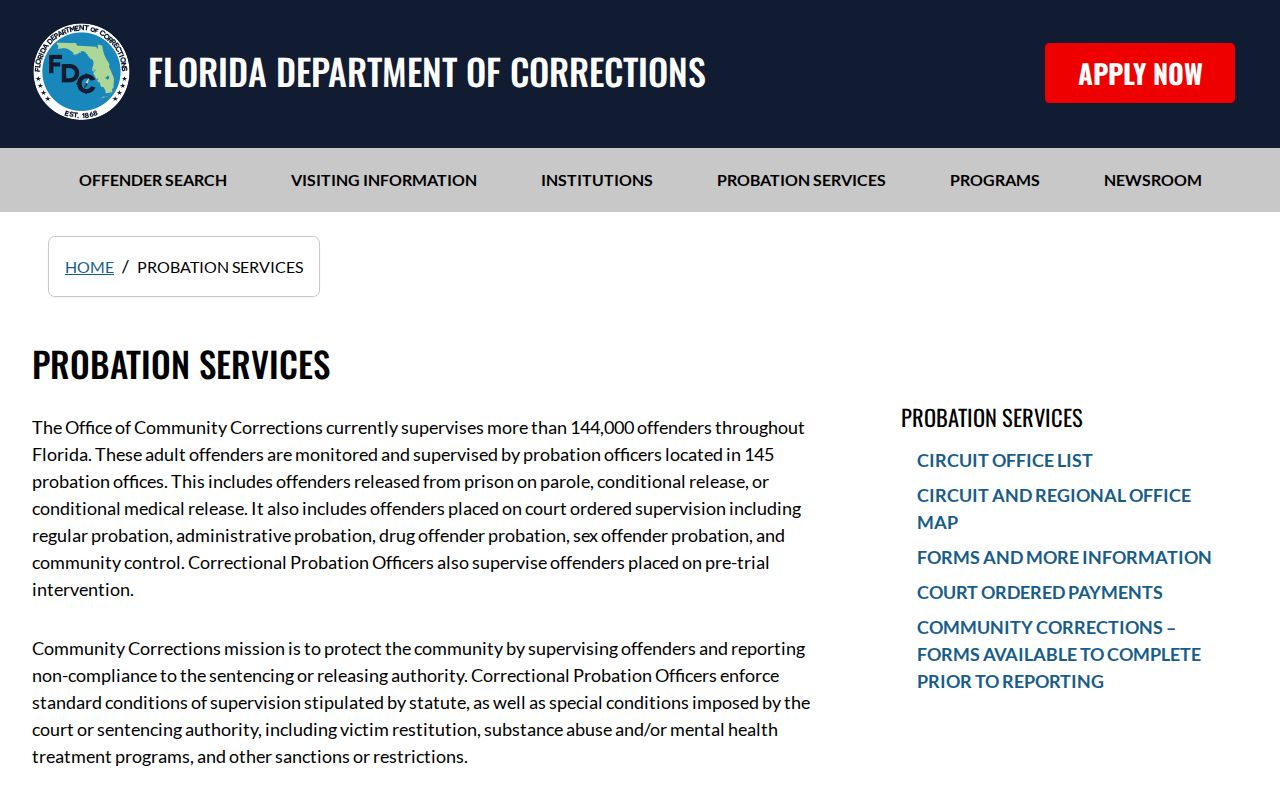
This distinction prevents a pretrial release status from being misread as a conviction or sentenced probation term.
Miami-Dade Police Records Follow Jurisdiction
MDSO patrols county areas and provides specialized services, yet many incorporated cities keep their own police reports. City of Miami, Hialeah, and Miami Gardens records stay with those cities when their officers created them. Florida Highway Patrol, FDLE, school or university police, airport and seaport units, and federal agencies can also be custodians. A postal address that says Miami does not prove that MDSO or Miami Police wrote the report.
Use the incident number, officer agency, citation header, or arresting-agency field to route a request. Mutual aid does not mean each participating office has the full report. Start with the lead agency, then request a supplemental report only when needed. For MDSO material, Central Records lists an appointment-based public counter on weekdays from 9:00 a.m. to 4:30 p.m.; its online Public Records Center is described as the fastest route.
Criminal Records by City in Miami-Dade County
The three largest incorporated cities each create local police records, while county Corrections and Clerk systems take over the booking and criminal-court layers. Start with the city that made the report, then follow a jail number or police number into Miami-Dade County systems. The cards match the county's ranked city set.
Miami Criminal History
Use Miami Police and the city request portal for city-created reports, then CJIS for criminal cases.
Hialeah Criminal History
Hialeah Police keeps its reports; county Corrections and the Clerk hold later custody and court records.
Miami Gardens Criminal History
Miami Gardens keeps MGPD reports, including current city records and newer local routing after incorporation.